Bitcoin is a decentralized digital currency that has redefined how people think about money and value exchange. Launched in 2009 by a mysterious figure or group using the pseudonym Satoshi Nakamoto, Bitcoin introduced the world to the concept of a peer-to-peer financial system that does not rely on traditional banks xrp price usd, governments, or financial institutions. Over the years, Bitcoin has grown from a niche project to a global asset class with a multi-trillion-dollar market and millions of users worldwide.
Unlike traditional currencies issued by central banks, Bitcoin operates on a distributed ledger technology known as the blockchain. The blockchain is a transparent, immutable database that records every transaction ever made using Bitcoin. It is maintained by a global network of computers (nodes), all of which work together to validate and store transaction data. This decentralized structure ensures that no single entity has control over the network, making it resistant to censorship, fraud, and manipulation.
One of the most significant features of Bitcoin is its limited supply. Only 21 million bitcoins will ever be created, a cap hardcoded into the protocol. This fixed supply contrasts sharply with fiat currencies, which can be printed in unlimited amounts by central banks, often leading to inflation. Bitcoin’s scarcity, often compared to precious metals like gold, has earned it the nickname “digital gold. ” As demand for a scarce asset increases, so does its value—at least in theory. This supply limitation is one of the key reasons investors and institutions view Bitcoin as a long-term store of value.
The process through which new bitcoins are introduced into the system is called mining. Mining involves powerful computers solving complex mathematical puzzles to validate and confirm transactions on the blockchain. In return for their work, miners are rewarded with newly created bitcoins and transaction fees. This process not only secures the network but also serves as the mechanism for distributing new coins. However, as more bitcoins are mined, the reward for miners is halved approximately every four years in an event known as the “halving. ” This gradual reduction in supply issuance is designed to mimic the scarcity and difficulty of extracting physical commodities like gold.
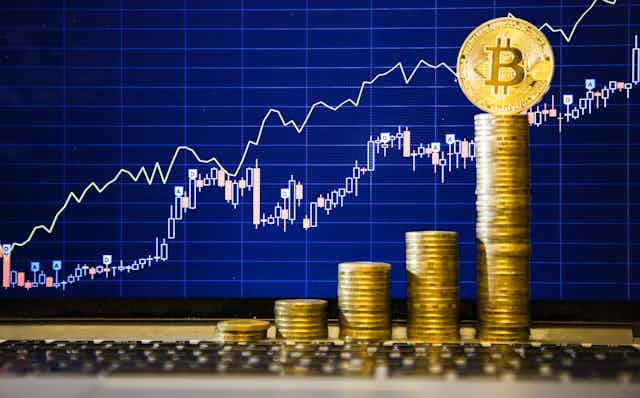
Bitcoin’s price history is one of dramatic highs and lows. What began as a virtually worthless token traded among a small group of enthusiasts has become a high-value digital asset traded on global exchanges. While Bitcoin has reached all-time highs above $60, 000 per coin, it has also experienced significant downturns, sometimes losing over half its value in short periods. This volatility is both a risk and an opportunity for traders and investors. It has led to skepticism from some financial experts but has not deterred the growth of the ecosystem.
One of Bitcoin’s major appeals is its ability to operate independently of the traditional banking system. It enables users to send and receive money anywhere in the world, without intermediaries, and often at lower fees. This capability is especially valuable in countries with unstable currencies, restrictive banking regulations, or high remittance costs. In some regions, Bitcoin has become a critical tool for financial inclusion, allowing people without access to banks to store and transfer wealth securely.
Security and ownership are central to the Bitcoin experience. Users hold their coins in digital wallets, which are protected by cryptographic keys. Unlike traditional bank accounts, if someone loses their private key, they lose access to their bitcoins permanently. There is no customer service line to call or recovery process. This puts full responsibility on the user but also provides a level of autonomy that no centralized financial service can match. As a result, education and personal responsibility are essential for anyone looking to participate in the Bitcoin network.
As Bitcoin has grown in popularity, so has interest from institutions. Hedge funds, asset managers, and even publicly traded companies have begun to allocate part of their portfolios to Bitcoin. This institutional interest has brought more legitimacy and liquidity to the market. Furthermore, countries like El Salvador have even adopted Bitcoin as legal tender, signaling a willingness to explore alternatives to the traditional monetary system. At the same time, other governments have imposed restrictions or outright bans on Bitcoin, citing concerns about financial stability, criminal activity, and investor protection.
Regulation remains one of the most critical factors shaping Bitcoin’s future. Governments around the world are grappling with how to approach this new financial technology. Some seek to foster innovation and attract blockchain startups, while others focus on strict oversight and consumer safeguards. The regulatory environment will likely play a significant role in determining how widely Bitcoin is adopted and how integrated it becomes with the broader economy.
Technological developments also continue to advance Bitcoin’s capabilities. The Lightning Network, for example, is a second-layer solution designed to enable faster and cheaper transactions. It has the potential to make Bitcoin more viable as a medium of exchange, rather than simply a store of value. Ongoing upgrades to the Bitcoin protocol aim to improve scalability, privacy, and programmability without compromising the network’s core principles of decentralization and security.
In conclusion, Bitcoin represents more than just a digital currency. It is a fundamental rethinking of how value can be stored and transferred in the digital age. With its limited supply, decentralized architecture, and growing global user base, Bitcoin has sparked conversations around monetary policy, financial freedom, and technological sovereignty. While the road ahead is uncertain and filled with challenges, the impact of Bitcoin on the global financial system is already significant—and it is likely to grow in the years to come.